
The Closing Process for Sellers in Florida: A 2026 Master Checklist
A successful Florida closing is won in the first ten days of your listing, not the final hour spent at the title company. While most sellers focus on the initial handshake, the real work happens behind the scenes to protect your equity from hidden costs. Navigating the closing process for sellers in Florida often brings up valid fears about documentary stamps or the sudden anxiety of a buyer's repair request. You've worked hard to build value in your home, and you deserve a transition that's as smooth as a Gulf Coast sunset.
This guide empowers you to master every step with a precise, expert roadmap for 2026. We'll show you how to secure a 30-day transition and maximize your net proceeds by addressing potential hurdles before they even arise. From leveraging AI-driven buyer targeting to utilizing pre-listing inspections that stop negotiations in their tracks, you're about to see exactly how we turn complex legal obligations into a clear path toward your next big milestone.
Key Takeaways
- Navigate the typical 30-to-45-day timeline with confidence by understanding every milestone from the executed contract to the final wire transfer.
- Protect your equity by gathering essential "Home Identity" documents and addressing title liens early to avoid last-minute hurdles.
- Gain a clear financial picture of the closing process for sellers in Florida, including county-specific title insurance splits and documentary stamp tax obligations.
- Prepare for a seamless closing day by knowing exactly what to bring and how "wet" versus "dry" funding affects when you receive your proceeds.
The Florida Seller’s Closing Roadmap: What to Expect in 2026
The closing process for sellers in Florida marks the high-stakes period from an executed contract to the final funding of your sale. For sellers in the 2026 Gulf Coast market, this timeline typically moves with purpose over 30 to 45 days. You'll work alongside a specialized team including the title agent, escrow officer, and your DeFeo Luxury Properties expert to ensure every detail is handled with precision. To keep the transaction secure, escrow serves as the neutral third-party holding ground for all funds and legal documents until the real estate closing process is complete.
To better understand this concept, watch this helpful video:
The Critical Milestones of a 30-Day Sale
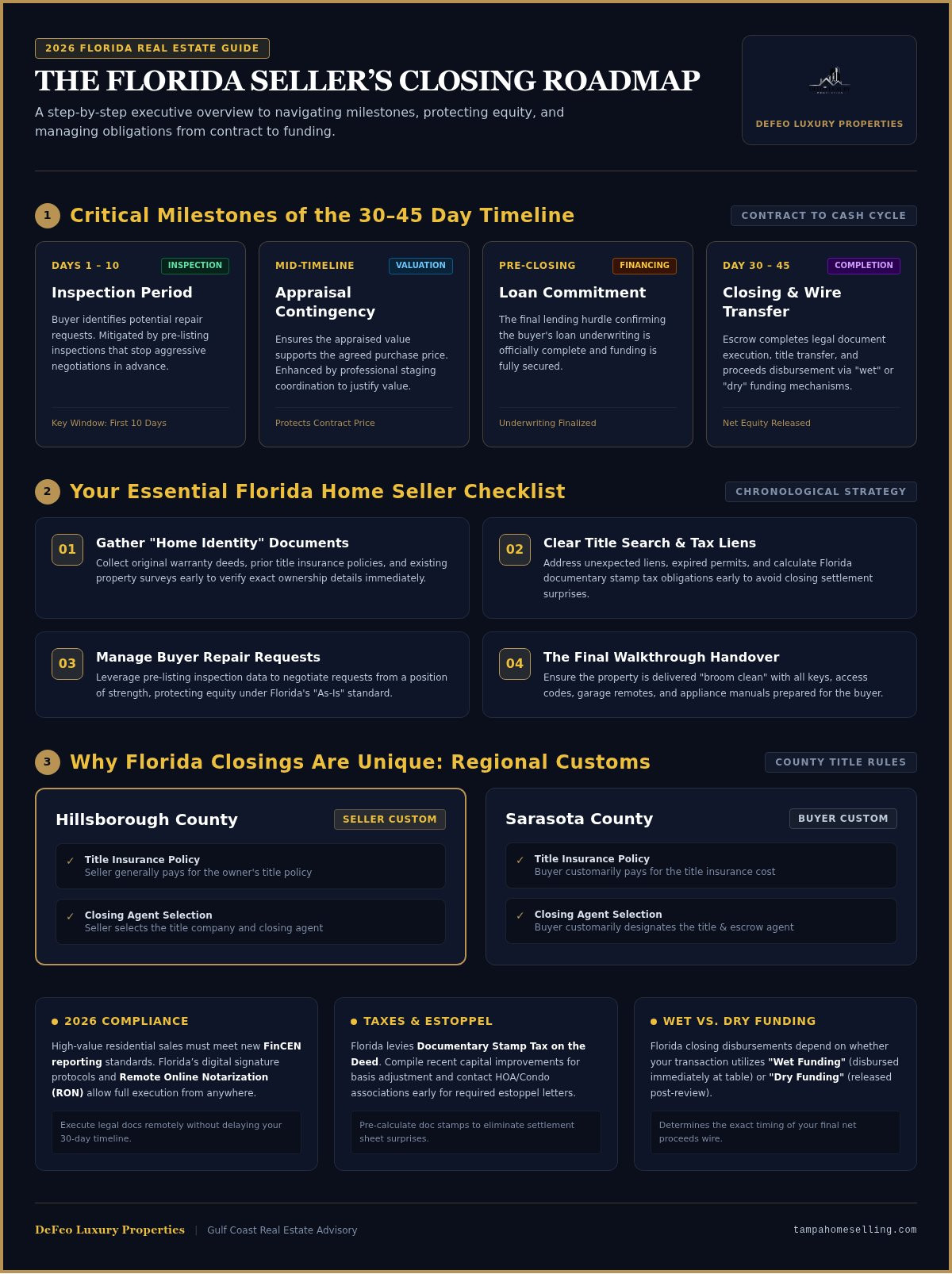
Efficiency is the hallmark of our 30-Day Home Selling System, which accelerates the traditional timeline through strategic preparation. The first 10 days constitute the inspection period, a vital window where buyers identify potential repairs. We mitigate this stress through pre-listing inspections that address issues before they become deal-breakers. Following this, the appraisal contingency ensures the home's value aligns with the purchase price. Professional staging coordination is essential here, as it helps justify the value to the appraiser. Finally, the loan commitment serves as the last hurdle, confirming the buyer's financing is fully secured.
Why Florida Closings Are Unique
The closing process for sellers in Florida relies heavily on the "As-Is" contract standard, which defines your repair obligations differently than in many other states. Local customs also shift depending on your specific zip code. In Hillsborough County, the seller generally pays for the title insurance policy and selects the title agent. Conversely, in Sarasota County, the buyer often picks up this cost. We track these regional nuances closely through DeFeo Luxury Properties to protect your equity and ensure your net proceeds are calculated accurately from the very start.
Your Essential Florida Home Seller’s Closing Checklist
A successful closing requires a proactive approach to your home's paper trail. Organizing your documents before the first offer arrives eliminates the friction that often stalls the closing process for sellers in Florida. We focus on a chronological strategy that moves you from contract to cash with total transparency.
- Step 1: Gather "Home Identity" Documents. Collect your original warranty deed, prior title policies, and property surveys to verify ownership details immediately.
- Step 2: Clear the Title Search. Address any surprise liens or expired permits early. This step is also the time to calculate your Florida documentary stamp tax to avoid surprises on your settlement statement.
- Step 3: Manage Repair Requests. Use our pre-listing inspection data to negotiate repairs from a position of strength, preventing buyers from chipping away at your equity.
- Step 4: The Final Walkthrough. Ensure the property is "broom clean" and all keys, remotes, and manuals are ready for the new owner.
Documentation You Need Ready on Day One
Speed is your greatest asset in the 2026 market. Compile a list of all recent capital improvements to help adjust your tax basis and justify your asking price. You'll also need current HOA or Condo Association contact information to secure estoppel letters without delay. Before you finalize your net sheet, check your home valuation to ensure your expectations align with local buyer demand.
2026 Compliance: What Sellers Must Know
Modern transactions involve specific reporting standards, including new FinCEN requirements for high-value residential sales. Florida's advanced digital signature protocols and Remote Online Notarization (RON) make meeting these rules simple. These secure tools allow you to execute documents from your laptop, ensuring your 30-day timeline stays on track even if you've already started your move.
Navigating Title, Taxes, and Seller Closing Costs
One of the most critical phases in the closing process for sellers in Florida is the final financial reconciliation. You'll encounter "Doc Stamps on the Deed," a transfer tax that catches many unprepared sellers off guard. In most Florida counties, this rate is currently $0.70 per $100 of the total sale price. For a $500,000 sale, this results in a $3,500 tax that is typically deducted from your proceeds at the table.
Title insurance costs also vary by local custom. In Hillsborough County, the seller traditionally pays for the owner’s policy and selects the title agent. However, in Sarasota County, the buyer often covers this expense. If you're a non-resident seller, you must also navigate FIRPTA withholding requirements. This federal law ensures the IRS receives capital gains taxes from foreign persons selling U.S. property, often requiring a 15% withholding of the gross sales price.
You'll receive a Closing Disclosure (CD) at least three days before settlement. This document provides a final itemized list of all costs and credits. Reviewing this against the CFPB closing guidelines and checklist ensures every penny is accounted for before you sign.
Estimating Your Net Proceeds
Your final check isn't just the sale price minus commissions. To get an accurate figure, we must account for existing mortgage payoffs, per-diem interest, and pro-rated property taxes. We also factor in HOA dues and any "Seller Credits" agreed upon during negotiations. These credits can reduce your final bottom line but often serve as the necessary lever to secure a premium offer.
The Role of the Title Company
The title company serves as the transaction’s referee, ensuring all liens are satisfied and the deed is recorded correctly. We pair this oversight with our AI-driven buyer targeting, which identifies serious buyers using lenders with a proven track record of on-time closings. This proactive approach minimizes the risk of financial delays. To see how these costs impact your specific move, request a professional home valuation today.
The Finish Line: Closing Day and the DeFeo Advantage
Closing day represents the successful conclusion of the closing process for sellers in Florida. To ensure a seamless handover, arrive with your government-issued photo ID, all property keys, and garage door openers. We also recommend leaving a folder for the new owners containing appliance manuals and any transferable warranties. Our 30-Day Home Selling System is designed to eliminate the friction of the final 48 hours, allowing you to focus on your move rather than last-minute paperwork hurdles.
Understanding when your funds arrive is vital for your financial planning. In a "wet closing," the lender funds the loan immediately, and you often receive your wire transfer or check before leaving the table. A "dry closing" occurs when the documents are signed, but the actual disbursement of funds happens later, often due to a delay in lender review or recording. We coordinate closely with the title company to prioritize your funding so you can access your equity without unnecessary waiting periods.
Signing the Final Documents
You'll sign several critical instruments during the settlement. The Warranty Deed acts as the formal vehicle for transferring ownership, providing the buyer with a guarantee of clear title. Additionally, the Bill of Sale documents the transfer of personal property, such as kitchen appliances or custom window treatments. Once the ink is dry, remember to cancel your utilities and update your address with the USPS to finalize your departure from the property.
Your Next Move on the Gulf Coast
Your journey doesn't have to end at the closing table. Many of our clients transition immediately from seller to buyer through our VIP Buyer Program, which gives you a competitive edge in a fast-moving market. If you're ready to explore the next chapter of your life, browse the latest Sarasota luxury homes to find a property that matches your lifestyle. We remain your dedicated regional guide, ensuring every milestone is met with total competence and local expertise.
Secure Your Equity and Move with Confidence
Mastering the closing process for sellers in Florida requires more than just signing papers; it demands a strategic approach to documentation, local tax customs, and timeline management. By organizing your Home Identity files and anticipating county-specific title costs early, you transform a complex transaction into a predictable success. You've built significant value in your property, and protecting that equity is our highest priority as your regional guide.
Our 30-Day Home Selling System combines AI-driven buyer targeting with deep expertise across Tampa, St. Pete, and Sarasota to ensure your transition is both fast and profitable. We eliminate the uncertainty of surprise repairs and slow-moving lenders, keeping your momentum strong until the final wire transfer hits your account. When you're ready to take the next step toward your future, Get Your Free Home Valuation and 30-Day Selling Strategy. Your next chapter on the Gulf Coast is waiting, and we're here to make sure you arrive there with total peace of mind.
Frequently Asked Questions
How long does the closing process typically take for sellers in Florida?
The closing process for sellers in Florida typically spans 30 to 45 days from the executed contract to the final funding. While this is the industry average, our 30-Day Home Selling System leverages AI-driven targeting to find serious buyers faster. This efficiency reduces the risk of deals falling through and keeps your move on a predictable track. Factors like buyer financing and inspection results ultimately dictate the final timeline.
Who usually pays for title insurance in Florida, the buyer or the seller?
Responsibility for title insurance premiums depends on local customs within each county. In Hillsborough and Pinellas counties, the seller traditionally pays for the owner’s title insurance policy and chooses the title company. Conversely, in Sarasota and Manatee counties, the buyer often assumes this cost. We navigate these regional nuances daily to ensure your net sheet accurately reflects the specific standards of your Gulf Coast neighborhood.
What are the typical closing costs for a seller in the Tampa Bay area?
Sellers in the Tampa Bay area can expect to pay between 6% and 9% of the sale price in total closing costs. This includes real estate commissions, documentary stamp taxes, and title search fees. You'll also see pro-rated property taxes and HOA dues on your settlement statement. We provide a detailed net sheet early in the process so you can see exactly how these figures impact your final proceeds.
Can I close on my Florida home remotely if I am out of state?
You can absolutely close on your home remotely using Florida’s secure Remote Online Notarization (RON) protocols. This technology allows you to complete the closing process for sellers in Florida from anywhere in the world with a stable internet connection. We coordinate with the title agent to ensure all digital documents meet 2026 compliance standards. This flexibility is a significant advantage for our out-of-state clients and seasonal residents.
What is the "Doc Stamp" tax, and how is it calculated for sellers?
The Florida documentary stamp tax is a mandatory excise tax on the transfer of real property. In most counties, including those throughout the Tampa Bay region, the rate is $0.70 for every $100 of the total purchase price. For example, a $400,000 sale incurs a $2,800 tax. This amount is automatically deducted from your equity at closing and paid directly to the Florida Department of Revenue to record the deed.