Selling a House 'As-Is' in Florida: The 2026 Strategic Seller’s Guide
Selling a house that needs repairs in Florida doesn't have to mean handing over your equity to the first investor who slides a lowball offer under your door. That assumption costs Florida homeowners real money every single day, and it's one worth challenging head-on.
If your property needs work and you're weighing an as-is sale, you already know the anxiety that comes with it: the fear of being taken advantage of, the confusion around what Florida law actually requires you to disclose, and the sheer exhaustion of even considering a contractor parade through your home. Those concerns are completely valid, and you're not alone in feeling them.
Here's what this guide will actually deliver. You'll get a clear-eyed look at the real price gap between an as-is listing and a repaired one, a breakdown of Florida's disclosure obligations so you can close with confidence, and a strategic comparison of your options, from investor cash offers to open-market alternatives that use buyer-targeting technology to find qualified buyers fast. An as-is sale isn't a retreat; it's a strategy. Let's make sure it's the right one for you.
Key Takeaways
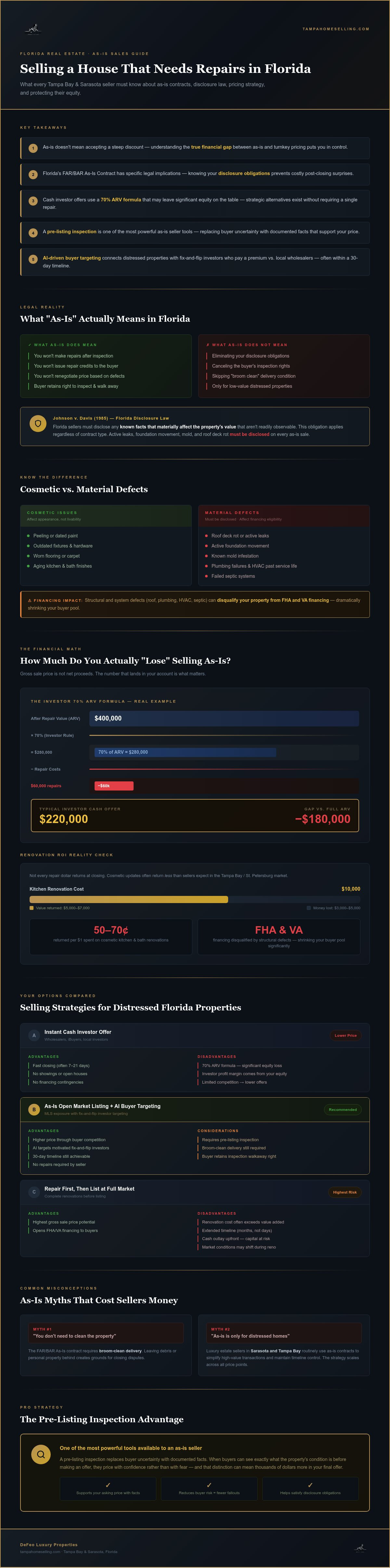
- Selling a house that needs repairs in Florida doesn't automatically mean accepting a steep discount - understanding the true financial gap between as-is and turnkey pricing puts you in control of the negotiation.
- Florida's FAR/BAR As-Is Residential Contract has specific legal implications for Tampa Bay sellers, and knowing your disclosure obligations upfront can prevent costly surprises at closing.
- Cash investor offers typically follow a 70% ARV formula that may leave significant equity on the table - but strategic alternatives exist that can attract higher bids without requiring a single repair.
- A pre-listing inspection is one of the most powerful tools an as-is seller can use, replacing buyer uncertainty with documented facts that support your asking price.
- AI-driven buyer targeting can connect your distressed property with fix-and-flip investors and qualified buyers who will pay a premium compared to local wholesalers - often within a 30-day timeline.
What Does 'Sold As-Is' Really Mean in the Florida Market?
The phrase gets thrown around constantly, but its legal weight surprises a lot of sellers. Selling as-is in Florida means one specific thing: you're telling the buyer upfront that you won't make repairs, issue credits, or renegotiate price based on defects discovered during the inspection period. That's it. It's a position on repairs, not a blanket shield from your obligations as a seller.
The instrument that governs most of these transactions is the Florida Realtors/Florida Bar (FAR/BAR) "As-Is" Residential Contract. Used throughout Tampa, Sarasota, and the surrounding Hillsborough and Sarasota County markets, this contract preserves the buyer's right to conduct inspections and walk away during the inspection period for any reason, or no reason at all. Sellers sometimes misread this as a weakness. It's actually a feature that keeps deals cleaner, because buyers who proceed past inspection have accepted the property's condition with eyes open.
Selling a house that needs repairs in Florida means understanding that "as-is" does not eliminate the inspection process. It simply removes your obligation to respond to it with your checkbook.
The Legal Reality of Florida Disclosures
The 1985 Johnson v. Davis ruling established that Florida sellers must disclose any known facts that materially affect the property's value and aren't readily observable by the buyer. Selling as-is does not change this obligation. A leaky roof, active foundation movement, or known mold issue must be disclosed regardless of contract type. The Seller's Property Disclosure form is your practical tool here; completing it accurately creates a documented record that protects you from post-closing litigation far more effectively than silence ever could.
In 2026's market, the distinction between cosmetic issues and material defects carries real financial consequences. Peeling paint or dated fixtures are cosmetic. Roof deck rot, plumbing failures, and HVAC systems past their service life cross into material defect territory. Buyers, their agents, and their attorneys know the difference.
Common Misconceptions About As-Is Sales
Two myths persist and both cost sellers credibility at the negotiating table:
- Myth: You don't need to clean the property. Most Florida contracts, including the FAR/BAR As-Is form, require the home to be delivered in "broom clean" condition. Leaving behind debris or personal property creates grounds for dispute at closing.
- Myth: As-is is only for distressed homes. Luxury estate sellers in Sarasota and Tampa Bay routinely use as-is contracts to simplify high-value transactions, avoid repair negotiations on premium finishes, and maintain timeline control. The strategy scales across price points.
If you're evaluating your options for selling a house that needs repairs in Florida, understanding exactly what as-is does and doesn't protect you from is the foundation every smart decision gets built on.
The Financial Math: How Much Do You 'Lose' Selling As-Is?
The word "lose" deserves some scrutiny here. Selling as-is does mean accepting a lower gross sale price in most cases. But net proceeds tell a completely different story, and that's the number that actually lands in your bank account.
Cash investors operating in the Tampa Bay and Sarasota markets typically anchor their offers to a formula: 70% of After Repair Value (ARV) minus estimated repair costs. So on a home with a $400,000 ARV and $60,000 in needed repairs, that formula produces an offer around $220,000. That gap is real. What sellers often don't account for is what closes it.
Repair Costs vs. Market Value Increase
Not every dollar spent on repairs comes back at closing. A kitchen renovation that costs $10,000 in materials and labor might add $5,000 to $7,000 in appraised value in a mid-range St. Petersburg neighborhood. You've spent $10,000 to recover $5,000. That's not a renovation strategy; it's a subtraction problem. Cosmetic updates in kitchens and bathrooms tend to return less than sellers expect, particularly in markets where buyers are already adjusting offers downward for other factors.
Structural repairs are a separate category entirely. Roof replacements, failed septic systems, and active plumbing leaks aren't just expensive; they disqualify the property from FHA and VA financing. That single fact removes a significant segment of qualified buyers from your pool. Conventional buyers who remain will factor the repair cost into their offers anyway, often overestimating the expense. Selling a house that needs repairs in Florida without addressing FHA/VA-blocking defects means you're negotiating in a narrower market regardless of your asking price.
Calculating Your Net Proceeds
Here's a simplified comparison on a Tampa home with a $400,000 ARV and $60,000 in deferred maintenance:
- Investor cash offer (70% ARV minus repairs): Approximately $220,000. No agent commissions, no closing costs typically, 7-day close. Holding costs: near zero.
- Traditional list after repairs: Gross sale near $390,000 after $60,000 in repairs. Subtract 5-6% in agent commissions, closing costs, and 3-4 months of carrying costs including taxes, insurance, and utilities. Net proceeds land closer to $300,000 to $310,000.
- As-is open market listing with targeted buyer outreach: Gross sale in the $330,000 to $350,000 range targeting fix-and-flip investors and cash-qualified buyers. Reduced commissions, 30-day close, zero repair spend. Net proceeds in the $290,000 to $305,000 range.
The gap between a cash investor offer and a strategic open-market as-is sale is often $60,000 to $80,000 on a mid-range Tampa property. That's not a rounding error.
For sellers who genuinely need a 7-day close due to relocation, probate, or financial pressure, the speed premium is legitimate and worth real money. For everyone else, the math usually favors a smarter listing strategy over the first envelope that arrives. Use the Home Valuation Tool to establish your property's baseline ARV before you evaluate any offer; knowing that number is the single most important step when selling a house that needs repairs in Florida.
Strategic Alternatives: Listing 'As-Is' vs. Instant Cash Offers
Two paths exist for selling a house that needs repairs in Florida, and neither one is universally correct. The right choice depends entirely on your timeline, your equity position, and your tolerance for uncertainty. What most sellers don't realize is that these two paths aren't as far apart as the real estate industry makes them seem.
Pros and Cons of the Instant Cash Exit
An Instant Cash Offer removes almost every variable from the equation. No showings, no repair negotiations, no financing contingencies, and a closing date you can put on your calendar with confidence. For sellers navigating foreclosure timelines, probate proceedings, or severe structural damage that makes the property genuinely unshowable, that certainty carries real value.
The trade-off is straightforward: you're paying for that certainty with equity. As the previous section established, the 70% ARV formula that most cash buyers apply produces offers that routinely leave significant money on the table for sellers who have more flexibility than they realize. An Instant Cash Offer is the right tool for a specific situation, not a default strategy for every distressed property.
The Power of AI-Driven Buyer Targeting
Here's where the calculus shifts dramatically. Local wholesalers operate within a tight geographic radius and a fixed acquisition formula. Regional and national fix-and-flip investors operate differently; they're actively searching for properties in specific counties with specific characteristics, and they'll pay more to acquire the right deal without fighting through a wholesaler's margin.
AI-driven buyer targeting identifies exactly those buyers. For properties in Hillsborough County or Pinellas County, this means connecting your listing with investors who are already pre-qualified, actively capitalized, and searching for as-is opportunities in your specific submarket. That's a fundamentally different buyer pool than a yard sign and a prayer.
Professional photography matters here more than most sellers expect. An as-is listing presented with clear, well-lit photography and a compelling "investment opportunity" narrative signals professionalism to sophisticated buyers. It replaces suspicion with confidence and invites competitive offers rather than discouraging them.
DeFeo Luxury Properties' 30-Day Home Selling System bridges exactly this gap, combining AI-driven buyer targeting with open-market exposure to generate competitive offers on as-is properties without requiring a single repair or a months-long listing period. Speed and price don't have to be opposites when the right buyers are in the room from day one.
How to Successfully Close an 'As-Is' Sale in the Tampa Bay Area
Knowing your options is half the battle. Executing the sale cleanly is the other half, and it's where sellers who've done their homework still get tripped up. Four steps separate a smooth as-is closing from a deal that falls apart at the finish line.
Step 1: Commission a pre-listing inspection. Nothing kills buyer confidence faster than uncertainty. A pre-listing inspection, completed before you accept a single offer, converts that uncertainty into documented fact. Buyers who know exactly what they're acquiring don't manufacture fear-based renegotiations. They price accordingly and proceed. That single investment routinely pays for itself many times over in preserved sale price.
Step 2: Price with precision, not optimism. An accurate professional valuation that accounts for your property's specific repair profile is non-negotiable. Overpricing an as-is listing signals inexperience to sophisticated buyers. It invites silence, not offers.
Step 3: Frame the narrative correctly. Market the property as an investment opportunity or blank canvas. That language attracts buyers who see potential rather than problems, which is exactly the mindset that produces competitive offers when selling a house that needs repairs in Florida.
Step 4: Verify proof of funds before you negotiate. An as-is buyer who can't close is worse than no buyer at all. Require documented proof of funds before entering serious negotiations. This is standard practice with institutional investors and should be standard practice with every buyer in your pipeline.
Navigating Inspections and Appraisals
Buyers who attempt to renegotiate price after the inspection period on a FAR/BAR As-Is contract are on shaky legal ground. Your pre-listing inspection documentation is your defense. Present it calmly, remind the buyer's agent what contract they signed, and hold your position. Sellers who fold here typically leave far more money behind than any repair would have cost.
Appraisal presents a separate challenge for buyers using conventional financing. Appraisers must note visible defects, and lenders may condition approval on repairs the seller has no intention of making. This is why targeting cash-qualified buyers and fix-and-flip investors matters so much; removing the financing contingency removes the appraisal problem entirely.
Choosing the Right Partner for Your Exit
The agent you choose for an as-is sale needs a specific skill set. They must understand the investor landscape in Sarasota County and Manatee County, know how to position distressed properties for maximum appeal to capital-ready buyers, and have the systems to generate competitive offers quickly. A generalist agent listing your as-is property the same way they'd list a turnkey home isn't a partner; they're a liability.
DeFeo Luxury Properties built the 30-Day Home Selling System specifically for sellers who need speed without sacrificing equity. AI-driven buyer targeting connects your property with the right investors before they find a competitor's listing. And if your timeline genuinely requires a faster exit, the Instant Cash Offer option is available for a direct comparison.
Don't accept the first envelope. Contact DeFeo Luxury Properties to see how the 30-Day System stacks up against an Instant Cash Offer for your specific property, because knowing both numbers is the only way to make a decision you won't second-guess at closing.
Your Next Move Starts With Knowing Your Number
Selling a house that needs repairs in Florida doesn't have to mean choosing between speed and equity. This guide has shown you the real financial gap between cash investor offers and open-market alternatives, what Florida's as-is contract actually requires of you, and the four steps that separate clean closings from deals that collapse at the finish line.
Three things are worth carrying forward. First, the 70% ARV formula is a starting point for negotiation, not a ceiling on what your property can achieve. Second, accurate disclosure protects you far more than silence ever will. Third, the right buyer pool changes everything, and AI-driven buyer targeting connects your property with capital-ready investors who compete for deals rather than dictate terms.
DeFeo Luxury Properties serves sellers across Tampa, Sarasota, and St. Pete with both the 30-Day Home Selling System and an Instant Cash Offer option, so you can compare both paths with real numbers before committing to either.
You've done the research. Now put it to work. Get your Instant Cash Offer or 30-Day Strategy here and close with confidence.
Frequently Asked Questions About Selling a House That Needs Repairs in Florida
Do I have to disclose a mold problem if I'm selling my house as-is in Florida?
Yes, absolutely. Florida's disclosure obligation under Johnson v. Davis applies regardless of contract type, and active mold is a material defect that must be disclosed. Selling as-is doesn't create a legal shield around known problems; it simply removes your obligation to fix them. Failing to disclose known mold exposes you to post-closing litigation that will cost far more than the disclosure ever would have.
Complete the Seller's Property Disclosure form accurately, document what you know and when you learned it, and let buyers make informed decisions. Buyers who proceed with that knowledge are far less likely to pursue legal action than buyers who discover it after closing.
Can a buyer back out of an 'as-is' contract after the inspection?
Yes, and that's actually by design. The FAR/BAR As-Is Residential Contract preserves the buyer's right to cancel during the inspection period for any reason, or no reason at all, and receive their deposit back. What buyers cannot do is use inspection findings to demand repairs or price reductions after the inspection period has expired. Once that window closes and the buyer proceeds, the as-is condition is accepted.
This is why pre-listing inspections are so valuable. When buyers already have documented facts about the property's condition before they make an offer, fewer of them use the inspection period as an escape hatch based on surprise.
Is it better to fix a roof or sell as-is in the current Tampa market?
For most Tampa sellers, the math favors selling as-is when a roof replacement is involved. A full roof replacement in the Tampa Bay area is a significant expense, and buyers frequently factor that cost into their offers anyway, often overestimating it. The bigger issue is financing: a roof in poor condition can disqualify the property from FHA and VA loans, which narrows your buyer pool considerably.
Rather than spending on a replacement, the smarter move is targeting cash-qualified buyers and fix-and-flip investors who price roof condition accurately and don't need lender approval to close. Selling a house that needs repairs in Florida with a strategic buyer-targeting approach often recovers more net equity than a roof replacement would.
How much lower should the price be for an as-is house compared to a renovated one?
There's no universal percentage, because the gap depends entirely on the type and severity of the repairs needed, the local submarket, and the buyer pool you're reaching. A home with purely cosmetic issues might price only 5 to 10 percent below a turnkey comparable. A property with structural or mechanical defects that block conventional financing can see a wider gap, though that gap shrinks significantly when you're negotiating with cash buyers who don't rely on appraisals.
The most reliable approach is starting with a professional valuation that accounts for your specific repair profile, then evaluating offers against that baseline. Accepting any offer without knowing your property's realistic market value is where sellers leave the most money behind.
Will selling as-is affect my ability to get a 'Love It or Leave It' guarantee?
DeFeo Luxury Properties does offer a Love It or Leave It Guarantee, and the best way to confirm exactly how it applies to your specific as-is situation is to speak directly with their team. Guarantee structures can vary depending on the sale strategy chosen, whether that's the 30-Day Home Selling System or the Instant Cash Offer path, and the specifics of your property's condition.
What's consistent is that both the 30-Day System and the Instant Cash Offer are designed to give sellers a clear, comparable picture of their options before committing to either. Getting that side-by-side comparison is the right first step, and it costs you nothing to see both numbers.