
Hidden Costs of Selling a Home in Florida: A 2026 Seller’s Guide
In Florida, your net proceeds are won or lost in the pre-listing phase, not just at the closing table. You've worked hard to build equity in your home, so it's natural to feel a sense of unease when calculating the hidden costs of selling a home in Florida. Between high insurance premiums affecting buyer negotiations and the specific math of documentary stamp taxes, the financial landscape of a 2026 sale requires a sharp, local perspective. You want to walk away with the highest possible return, but unexpected repair costs and closing fees can quickly erode your profit margin if you aren't prepared.
This guide will provide a transparent breakdown of the specific Florida fees and pre-sale expenses that impact your bottom line, teaching you exactly how to protect your equity. We'll examine everything from the $0.70 per $100 documentary stamp tax to the $299 statutory limit on HOA estoppel certificates. You'll gain a clear strategy to avoid over-improving your property before listing, ensuring you maximize your net proceeds through a smooth, professional process that puts your financial interests first.
Key Takeaways
- Identify the specific gap between your gross sale price and final net proceeds by establishing a clear Florida closing cost baseline before you list.
- Master the math behind documentary stamp taxes and HOA estoppel fees to accurately project the hidden costs of selling a home in Florida.
- Protect your equity by understanding how 2026 insurance concessions and strategic pre-sale repairs influence buyer negotiations and final offers.
- Leverage AI-driven buyer targeting and the 30-Day Home Selling System to reduce market time and eliminate the drain of ongoing holding costs.
- Navigate regional customs regarding title insurance and escrow requirements so you don't overpay for standard transaction fees.
Beyond the Commission: The Florida Seller’s Closing Cost Baseline
Selling your home involves more than just agreeing on a number and signing a deed. While the gross sales price looks impressive on a contract, your net proceeds represent the actual cash you'll walk away with after all obligations are met. Understanding the baseline seller’s closing costs is the first step in protecting your equity. These expenses include professional representation, administrative fees, and specific state taxes that often surprise sellers who haven't listed a property recently. By identifying these hidden costs of selling a home in Florida early, you can plan your next move with total financial confidence.
To secure the highest possible return, we utilize AI-Driven Buyer Targeting to find high-intent purchasers quickly. This strategic approach reduces the impact of the hidden costs of selling a home in Florida by ensuring you aren't paying unnecessary mortgage interest or utility bills while waiting for an offer. By identifying the right buyer early, you avoid the financial drain of extended market time and maintain momentum toward your goals.
To visualize how these expenses stack up, watch this breakdown of the standard costs involved in a Florida transaction:
The Role of Title Insurance in the Gulf Coast
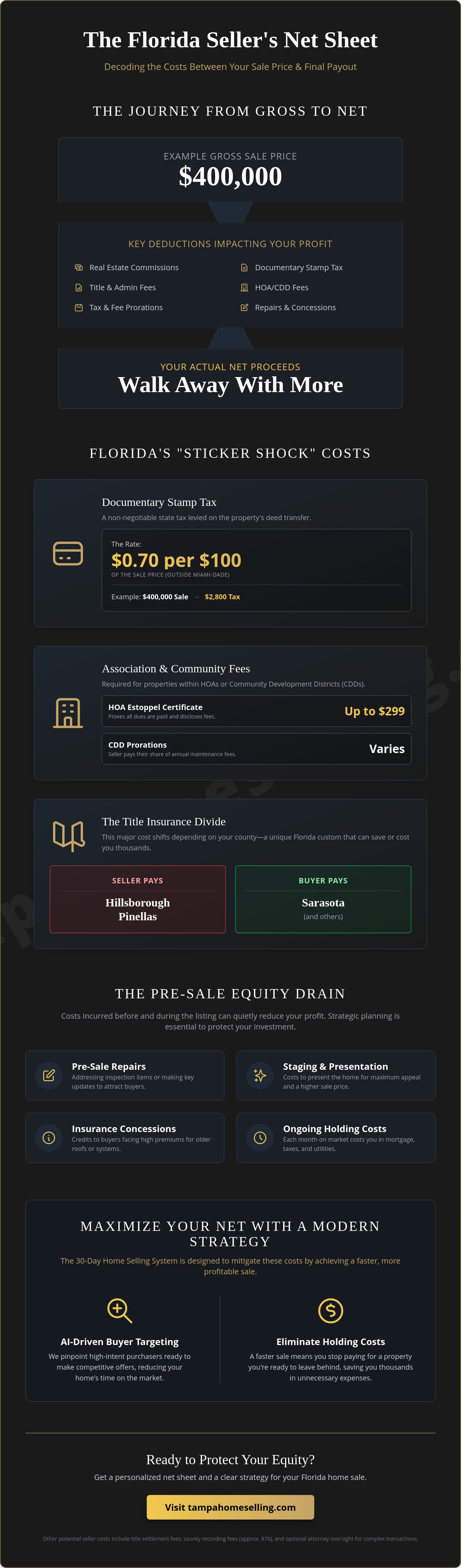
Florida is unique because the party responsible for paying title insurance varies by geography. In Hillsborough and Pinellas Counties, it's customary for the seller to provide the owner's title policy. However, if you are looking at Sarasota Florida Homes for Sale, the buyer traditionally picks up this tab. This regional nuance can save or cost you thousands of dollars, so knowing your local market standard is vital for an accurate net sheet.
Recording Fees and Real Estate Attorney Oversight
Professional transaction management ensures your sale stays on track and legally sound. You'll encounter settlement fees for the title company's work and recording fees of approximately $70 to officially document the deed with the county clerk. While Florida doesn't mandate an attorney for every sale, many sellers choose legal oversight to navigate complex title issues or high-stakes negotiations. These costs are investments in a smooth, effortless process that guards against future liabilities.
Florida-Specific 'Sticker Shock': Doc Stamps, CDDs, and HOA Estoppels
Florida’s tax structure offers many benefits, but the closing table reveals specific obligations that can catch you off guard. The most significant of these is the Documentary stamp tax on the deed. Outside of Miami-Dade County, the state charges $0.70 for every $100 of the sale price. This means a $400,000 sale triggers a $2,800 expense. It's a non-negotiable part of the hidden costs of selling a home in Florida that directly impacts your final check.
If your home is part of an association, you'll also face HOA Estoppel fees. Under Florida Statute Section 720.30851, these certificates can cost up to $299. This document proves to the title company that you're current on all dues and assessments. While it seems like a small administrative charge, it's one of several items that can accumulate during the final stages of the transaction. You should also verify if your community has additional transfer fees or capital contributions required from the seller at the time of closing.
Navigating CDD and HOA Transfer Costs
Sellers in master-planned communities like Lakewood Ranch or Parrish often deal with Community Development District (CDD) fees. These are split into annual operations and maintenance (O&M) and a capital debt portion. When you sell, you'll pay a prorated share of the O&M. Understanding these nuances is critical for those listing Single-Family Residential homes in Manatee County, where CDDs are standard. Don't forget property tax prorations. Since Florida taxes are paid in arrears, you'll credit the buyer for the portion of the year you owned the home. This credit is based on your current "Save Our Homes" assessed value, which may be significantly lower than the buyer's future tax bill.
Capital Gains Tax in the Florida Market
Florida’s lack of state income tax is a massive draw for residents, but federal rules still apply to your real estate profits. Most sellers can exclude up to $250,000 in gains, or $500,000 for married couples, if the home was their primary residence for at least two of the last five years. If your equity growth exceeds these limits, you'll need to prepare for a federal capital gains tax. To see how these factors might impact your bottom line, you can start by requesting a professional home valuation to establish your baseline equity.
The Pre-Sale Drain: Repairs, Staging, and Insurance Concessions
Preparing your home for the 2026 market involves more than a fresh coat of paint. In Florida, the "Insurance Concession" has become a standard hurdle. Because buyers struggle to secure coverage on older homes, you may be asked to fund roof repairs or electrical upgrades before a lender will even approve the loan. This requirement is a major component of the hidden costs of selling a home in Florida. Often, sellers must pay for a four-point inspection upfront to satisfy buyer insurance carriers and keep the deal from collapsing.
Presentation matters, especially in high-end markets like St. Pete Beach. Professional staging provides a significant return on investment by helping buyers visualize a luxury lifestyle. When you combine these pre-sale preparation costs with the Florida Documentary Stamp Tax paid at closing, your initial equity can shrink faster than expected. Small investments in deep cleaning and curb appeal prevent buyers from using minor flaws as leverage for large price drops.
Don't overlook the cost of holding your property. For a $350,000 home, carrying costs like mortgage payments, taxes, and insurance can reach approximately $2,200 per month. Every week your home sits on the market is money out of your pocket. To protect your proceeds, consider requesting a professional home valuation to determine if an Instant Cash Offer is the right path for your timeline.
Staging vs. Selling "As-Is"
Deciding between staging and selling "As-Is" depends on your timeline and budget. While professional staging costs money upfront, an empty home often sits longer and invites lower offers. If you prefer to skip the repairs and staging, you can learn more about Selling a House As Is in Florida to see if it fits your financial strategy.
Pre-Listing Inspections: The Ultimate Hedge
Spending a few hundred dollars on an inspection before you list prevents thousands of dollars in credits during the buyer’s contingency period. A pre-listing inspection is a proactive tool to lock in the sales price by identifying issues you can fix on your own terms. This transparency builds buyer trust and ensures a smoother path to the closing table.
Maximizing Your Net: The 30-Day Home Selling System Advantage
Speed is your best defense against the hidden costs of selling a home in Florida. Every day your property remains active, you're responsible for the carrying costs we discussed earlier, including the $2,200 monthly average for mortgage, taxes, and insurance. Our 30-Day Home Selling System creates a framework for price certainty by generating immediate momentum through high-impact marketing. By utilizing AI-Driven Buyer Targeting, we find high-intent purchasers who are ready to move; this significantly reduces your time on market and keeps more equity in your pocket.
While some national platforms push an Instant Cash Offer as the only way to avoid stress, these options often result in lower net proceeds due to aggressive service fees. We provide an Instant Cash Offer as a convenient benchmark, but our goal is to show you how a strategic market sale can maximize your return. A key part of this strategy involves the pre-listing inspection. This proactive step eliminates the "repair surprise" during the buyer's contingency period, preventing thousands of dollars in last-minute price reductions and keeping the transaction on your terms.
Strategic Pricing for the Gulf Coast Market
Setting the right price from day one is essential to avoid the "stale listing" trap. When a home sits too long, buyers assume something is wrong, leading to low-ball offers that further increase the hidden costs of selling a home in Florida. You can access our Home Valuation Tool to receive a custom equity report based on real-time Gulf Coast data and recent comparable sales in your specific neighborhood.
Reducing Friction with Professional Representation
Expert guidance transforms a complex transaction into a smooth, effortless process. A professional agent coordinates everything from high-end staging to necessary repairs, ensuring you don't over-invest in upgrades that won't pay off. We handle the documentation, the negotiations, and the logistics so you can focus on your next chapter. Ready to secure your equity? Schedule your 30-Day Selling Consultation today to see how we maximize your net proceeds through specialized local expertise.
Secure Your Equity and Move Forward with Confidence
Selling a home on the Gulf Coast is a significant milestone that requires both strategic planning and local expertise. You've now seen how the hidden costs of selling a home in Florida, from documentary stamp taxes to insurance concessions, can impact your final net proceeds. By addressing repairs early and understanding regional fee structures in Tampa, Sarasota, and St. Pete, you place yourself in a position of strength. Our 30-Day Home Selling System and AI-Driven Buyer Targeting work together to eliminate the friction of a traditional sale, ensuring you don't lose money to unnecessary market delays. Whether you're navigating an HOA in Parrish or a luxury listing in St. Pete, specialized knowledge is your best asset.
Your goal is a smooth transition with maximum profit, and we're here to provide the data-driven guidance you need. Don't leave your net proceeds to chance. You can calculate your home’s value and estimated net proceeds today to get a clear picture of your financial future. We look forward to helping you achieve a successful, stress-free sale that celebrates your home's true value and protects your hard-earned equity.
Frequently Asked Questions
Who pays for the title insurance in Florida, the buyer or the seller?
Responsibility for title insurance depends entirely on the county where your property is located. In Hillsborough, Pinellas, and Manatee Counties, the seller customarily pays for the owner's title insurance policy. However, in Sarasota County, the buyer typically picks up this expense. Understanding these regional traditions is a vital part of calculating the hidden costs of selling a home in Florida, as it can shift thousands of dollars in obligations between parties.
What is the Florida Documentary Stamp Tax, and how much is it?
The Florida Documentary Stamp Tax is a mandatory transfer tax on the deed, which the state requires to record the change of ownership. Most Florida counties charge a rate of $0.70 per $100 of the sale price, meaning a $400,000 transaction triggers a $2,800 tax. Miami-Dade County uses a slightly different rate of $0.60 per $100 for single-family homes. This non-negotiable fee is paid at closing and directly impacts your final net proceeds.
Do I have to pay capital gains tax when I sell my Florida home?
You'll likely avoid federal capital gains tax if the property was your primary residence for at least two of the last five years. The IRS provides an exclusion for the first $250,000 of profit for individuals and $500,000 for married couples filing jointly. While Florida doesn't have a state income tax, you're still responsible for federal taxes if your equity growth exceeds these thresholds. Always consult a tax professional to review your specific financial situation.
How much should I budget for pre-sale repairs in Tampa?
Budgeting between $1,500 and $7,000 for pre-sale preparation and staging is a standard baseline for the Tampa market. This range typically covers professional deep cleaning, curb appeal enhancements, and minor cosmetic repairs that prevent price drops. In 2026, it's also wise to set aside funds for potential "four-point" inspection issues, like aging roofs or electrical panels, which are often required for a buyer to secure property insurance in the hidden costs of selling a home in Florida.
Are real estate commissions negotiable in the 2026 Florida market?
Real estate commissions are absolutely negotiable and currently average approximately 5.5% to 5.6% across the state. Since the 2024 NAR settlement, the structure of these fees has become more flexible, allowing for tailored agreements between sellers and their listing agents. While many sellers continue to offer a commission to the buyer's agent to attract more qualified purchasers, the specific split and total rate are items you can discuss during your initial consultation.